Description
Condition: NEW — Brand new, factory-sealed unit. Manufacturer Part #: MS225-48LP-HW
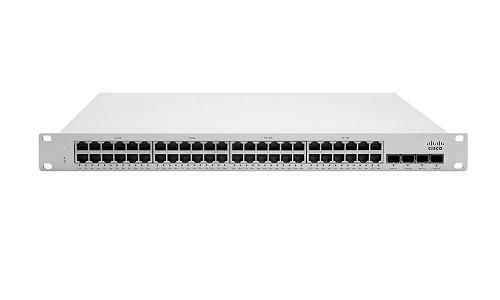
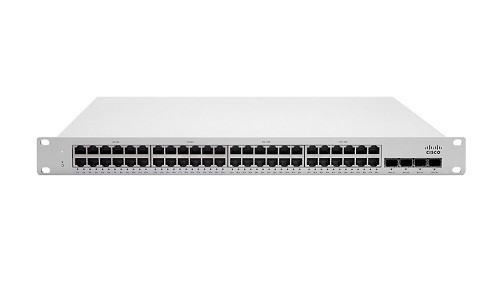
Cisco Meraki MS225-48LP 48-Port PoE+ Gigabit Switch — 370 W PoE Budget, 4 × 10G SFP+ Uplinks, 1U Rack Layer 2 Stackable Switch
The Cisco Meraki MS225-48LP brings PoE+ capability to the 48-port tier of the MS225 series, delivering up to 370 W of power across all 48 × 1 GbE RJ45 ports to support distributed wireless access points, IP cameras, and VoIP infrastructure. A fixed internal fan maintains thermal stability under continuous PoE load, while 176 Gbps of switching capacity and 4 × 10G SFP+ uplinks keep performance consistent at full port density. Two dedicated hardware stack ports allow seamless expansion up to the full MS225 stacking bandwidth of 80 Gbps.
Technical Specifications
| Device Type | Layer 2 Managed Stackable Switch |
| Form Factor | 1U Rack Mount |
| Ports | 48 × 10/100/1000 Mbps RJ45 (PoE+); 4 × 10G SFP+ uplinks; 2 × dedicated hardware stack ports; 1 × dedicated management interface |
| Power over Ethernet (PoE) | PoE+ (IEEE 802.3at) |
| PoE Budget | 370 W |
| Switching Capacity | 176 Gbps |
| Stacking Bandwidth | 80 Gbps (2 × dedicated hardware stack ports) |
| Management Protocols | Cisco Meraki Dashboard (cloud), SNMP, Syslog, HTTP |
| Key Features | Cisco Meraki cloud management, automatic firmware upgrades, SNMP/Syslog integration, IPv4/6 ACL support, 802.1q VLAN tagging, static routing, broadcast storm control, dynamic ARP inspection, DHCP snooping, 802.1X authentication, QoS, LLDP, DHCP relay, link aggregation (LACP), BPDU guard, root guard, zero-touch provisioning |
| Compliant Standards | IEEE 802.1D, IEEE 802.1Q, IEEE 802.1p, IEEE 802.3af, IEEE 802.3at, IEEE 802.3ad (LACP), IEEE 802.1w, IEEE 802.1x, IEEE 802.1ab (LLDP) |
| Fan Operation | Fixed Internal |
| Input Power | AC 120/230 V, fixed internal power supply |
| Dimensions (W×D×H) | 19 × 13.38 × 1.72 in |
| Weight | 9.63 lb |
Best Used For
Well suited for mid-size branch campuses where 48 PoE-powered endpoints — access points, phones, and cameras — must all be supported from a single switch with manageable power overhead. The 370 W budget provides efficient distribution across a typical mixed-device floor deployment.